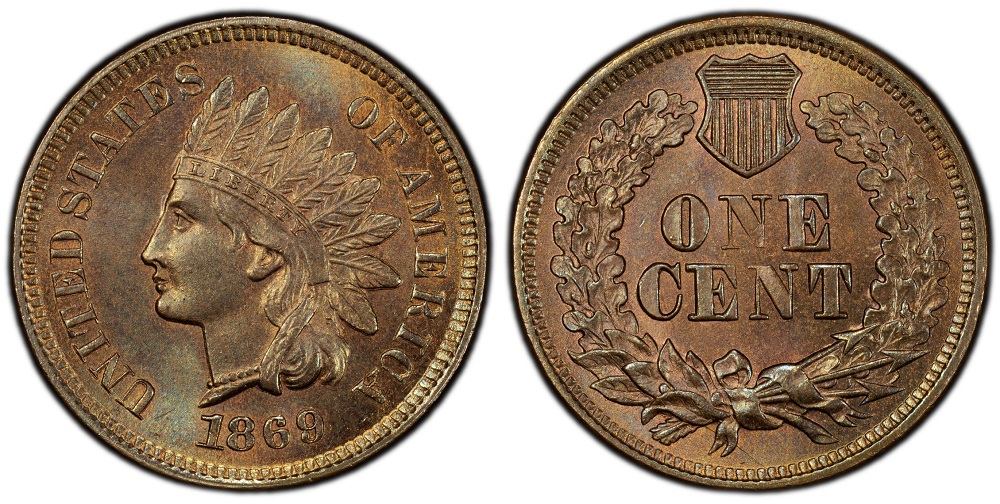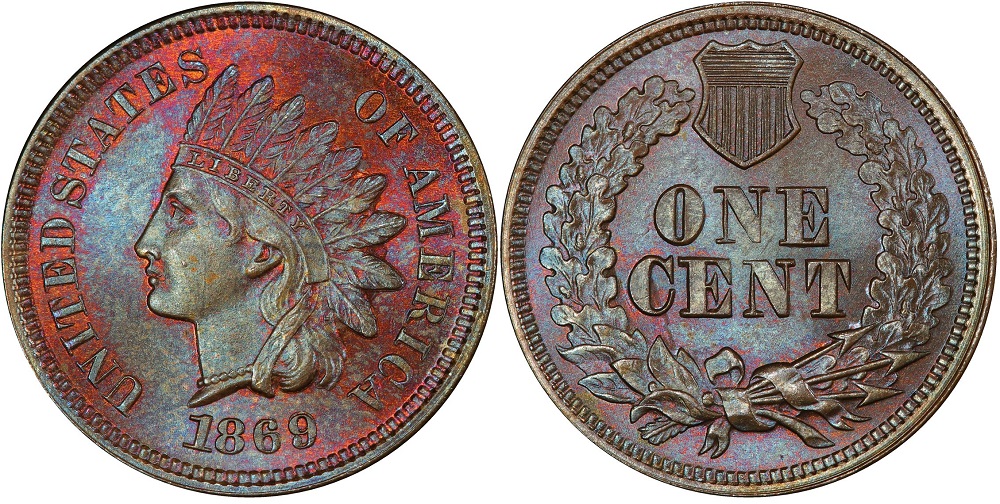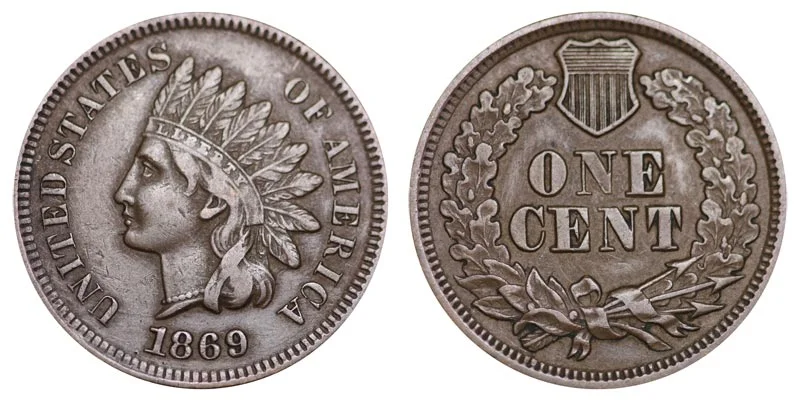
1869 Indian Head penny obverse and reverse showing Liberty head design and ONE CENT wreath

The 1869 Indian Head Penny: What Is Your Coin Worth?

A single gem-quality example sold for $84,000 at Heritage Auctions in 2019 — but most 1869 Indian Head cents in circulated condition trade for $90–$665. With only 6,420,000 struck (the lowest small-cent mintage in US history at the time) and mass meltings in the 1870s wiping out millions more, this is one of the most desirable semi-key dates in the entire Indian Head cent series.

Use the free tools below to find out exactly where your coin lands — from a heavily worn $90 specimen to a potential four-figure gem.

★★★★★ Rated 4.8/5 by 1,347 collectors · Free to use · No signup required
Check My 1869 Indian Head Penny Value →
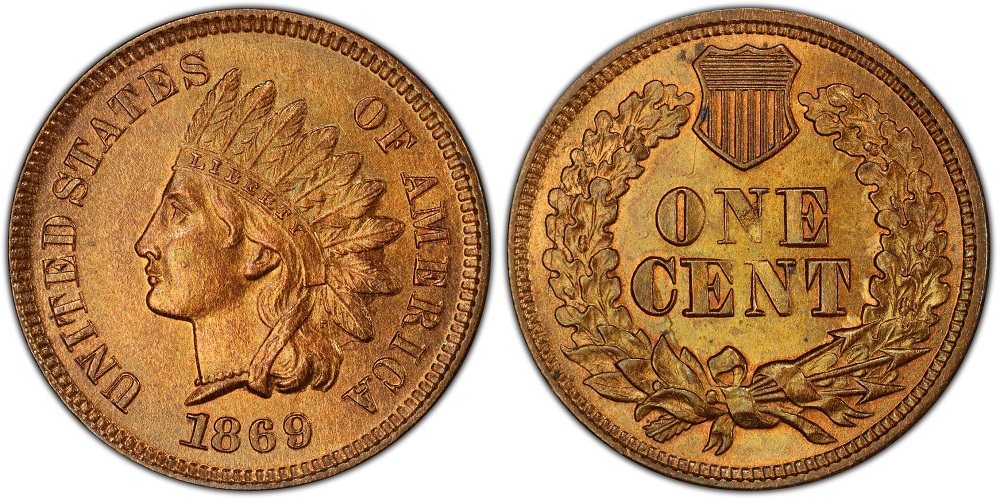
$84,000 Record auction sale (MS66+ RD, Heritage 2019)
6.42M Total mintage — lowest small cent in US history at the time
$90+ Minimum value — even heavily worn examples carry real premium
~600 Proof specimens struck — all command strong collector interest

Free 1869 Indian Head Penny Value Calculator

Select your coin's mint, condition, and any known varieties below, then click Calculate.

Step 1 — Mint Mark

Step 2 — Condition

Step 3 — Varieties / Errors (check any that apply)

If you haven't yet identified your coin's condition or mint details, there's a free 1869 Indian Head Penny Coin Value Checker that lets you upload a photo and get an AI-powered estimate without needing to know the grade first.

Describe Your 1869 Penny for a Detailed Assessment

Type what you see — the tool analyzes your description for key variety and condition indicators.

Mention these things if you can

  • LIBERTY legibility (all/some/none)
  • Date clarity — any doubling or ghost digits
  • Color: red / red-brown / brown
  • Luster present or absent
  • Any cuds or raised blobs on the rim

Also helpful

  • Digit tops visible in denticles below date
  • Die cracks or hairlines on surface
  • Reverse — deep mirror or normal fields
  • Sharpness of feather tips in the headdress
  • Any cleaning, polishing, or spots noted

Skipped the calculator?

Go back up and select your mint, condition, and any errors — it takes under 30 seconds and gives you a specific value range for your exact coin.

Use the Free Calculator →

1869/9 Overdate Self-Checker

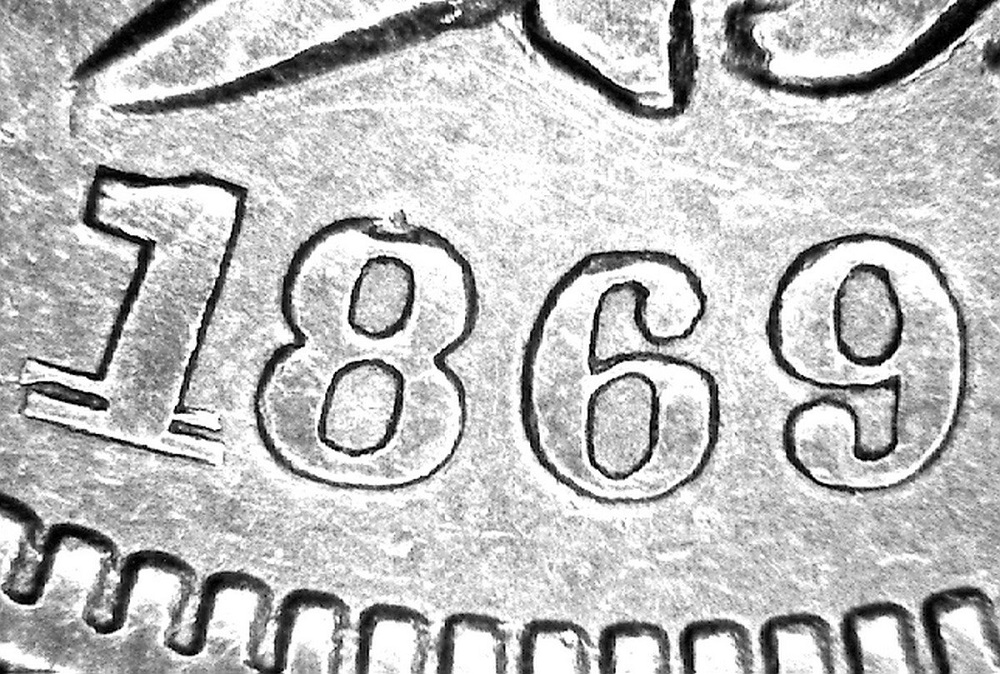
The 1869/9 overdate (Snow-1, FS-301) is the most sought-after variety of this date. Under a 10× loupe, secondary digit impressions from the first die-punching are visible above the primary date digits. This variety commands a significant premium — often 2–3× the value of a regular 1869 in the same grade.

Side-by-side comparison: regular 1869 Indian Head penny date vs 1869/9 overdate showing repunched digit impressions above the primary 9

🔹 Regular 1869 — What to Expect

Clean date digits with no secondary impressions. The '9' sits neatly in the field with no ghost curves or serif remnants above it. Die cracks (if present) run through the legends but do not indicate the overdate variety.

🏆 1869/9 Overdate (Snow-1) — What Makes It Rare

A secondary set of digit remnants is visible above the primary date, especially above the '9'. Under 10× magnification, look for curved remnants or serif tops of earlier punched digits peeking above the baseline of the primary date. Also look for repunched 1 and 8 impressions north of the primary digits.

Run the 4-Point Check

1869 Indian Head Penny Value Chart at a Glance

The table below summarizes current market values across all major varieties and conditions. For a thorough in-depth 1869 Indian Head penny identification breakdown and reference, with illustrated grading examples, that resource covers the full attribution process step by step. Values below are based on PCGS Price Guide data and recent auction results; actual realized prices vary by eye appeal, color designation, and certification.

Variety Worn (G–VG) Circulated (F–EF) Uncirculated (MS-60–63) Gem (MS-64+)
Regular 1869 (BN) $90–$148 $313–$559 $929–$1,064 $1,847–$3,000+
Regular 1869 (RB) $950–$1,195 $2,573–$3,800+
Regular 1869 (RD) $1,000–$1,453 $3,280–$22,600+
1869/9 Overdate Snow-1 SIGNATURE $175–$275 $500–$900 $1,500–$2,500 $4,000–$31,200+
Snow-2 RPD (w/ die cracks) $100–$175 $350–$650 $1,000–$1,800 $2,500–$5,000+
Misplaced Date Snow-8 RAREST $150–$250 $400–$750 $1,200–$2,000 $3,000–$6,000+
Reverse Cud Varieties $100–$160 $325–$600 $1,000–$1,600 $2,200–$4,500+
Proof (PR-63–65) Not applicable $458–$900 $1,500–$3,500+

⚠️ Values are estimates based on PCGS Price Guide and recent Heritage/eBay auction data (2025–2026). Get your coin certified for binding valuations.

📱 CoinHix is a quick on-the-go way to scan your 1869 Indian Head penny and get an instant value estimate from your phone — a coin identifier and value app.

Everything on This Page

Jump directly to any section:

The Valuable 1869 Indian Head Penny Errors (Complete Guide)

The 1869 Indian Head cent was produced at Philadelphia using multiple working dies, and the pressures and hand-punching practices of the era created a rich landscape of collectable varieties. Die marriage attribution for this date follows the Rick Snow reference system, with additional cross-references to the Cherrypickers' Guide (FS numbers) for the most commercially significant varieties. The four varieties below represent the most actively traded and widely searched examples — each with distinct diagnostics that can be verified with a 10× loupe at home.

1869/9 Indian Head penny overdate showing repunched secondary digit impressions above the primary date numerals
Most Famous
$175 – $31,200+

1869/9 Overdate (Snow-1 / FS-301)

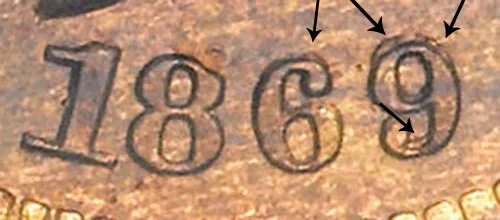
The 1869/9 overdate is the single most commercially recognized variety for this date. It occurred when the date-punching hub was applied to the working die twice, with the second impression landing squarely atop the first. The entire date was effectively doubled, leaving ghostly remnants of the initial punching visible above the primary digits.

Under a 10× loupe, collectors look for a secondary curved line above the top of the final '9' — the most visible diagnostic. The '1', '8', and '6' also show faint repunched impressions to the north. On later die states, progressive die cracks running through the obverse legends are an additional confirmation.

The overdate carries a 2–3× premium over a regular 1869 in the same condition because it is listed in the Cherrypickers' Guide as FS-301 and is actively sought by variety specialists. A PCGS-graded example in MS66+ Red sold for $31,200 at Heritage Auctions in 2025, confirming strong collector demand at the gem level.

How to spot it

With a 10× loupe, examine the top edge of the final '9' in the date. A faint curved serif or remnant line above the primary numeral confirms the overdate. Also check the '8' for a secondary impression above the upper loop.

Mint mark

P — Philadelphia only (no mint mark on coin)

Notable

Catalogued as FS-301 in Cherrypickers' Guide. Cross-referenced Snow-1 and FND-001. MS66+ RD example sold for $31,200 at Heritage Auctions (March 2025). Listed as the top RPD for the 1869 date by Indian Cent variety specialists.

1869 Indian Head penny Snow-2 repunched date variety with die crack visible through the reverse wreath area
Most Collectable
$100 – $5,000+

Snow-2 Repunched Date with Die Cracks

The Snow-2 variety features its own distinct repunched date with secondary impressions visible within the lower loops of the '8' and '6' — different diagnostics than the Snow-1 overdate. This die also shows significant obverse die cracks emanating from the rim, progressing across the legend through use of the die throughout its working life.

The obverse die crack system is one of the most visible features: a crack running through the top of "ED ST" and another from the rim through "TE" are referenced in variety catalogs. The reverse shows complementary cracking. Later die states exhibit a retained cud or progressive cud between 7:30 and 9:30 on the reverse, significantly enhancing value for cud collectors.

Snow-2 appears on PCGS certified examples catalogued under the MS62 RB holder noted at $900 in Heritage Auctions (September 2025). Die progression collectors prize late-die-state examples of this variety because the crack severity increases dramatically from early to late die states — making diagnostic identification part of the collecting challenge.

How to spot it

Using a 10× loupe, look for secondary digit impressions within the loops of the '8' and '6' — not above the numerals as in Snow-1. Also look for obverse die crack running through "ED ST" from the upper rim area; this is the strongest confirming diagnostic alongside the RPD.

Mint mark

P — Philadelphia only (no mint mark)

Notable

Cross-referenced as Snow-2 with multiple die states documented (Snow-2, 2a through progressive cud). PCGS MS62 RB example sold for $900 at Heritage Auctions (September 2025). Late die states with full retained cud on the reverse command a significant additional premium from cud variety specialists.

1869 Indian Head penny Snow-8 misplaced date variety showing faint digit tops in the denticles below the date
Rarest
$150 – $6,000+

Misplaced Date — Snow-8 / MPD-001

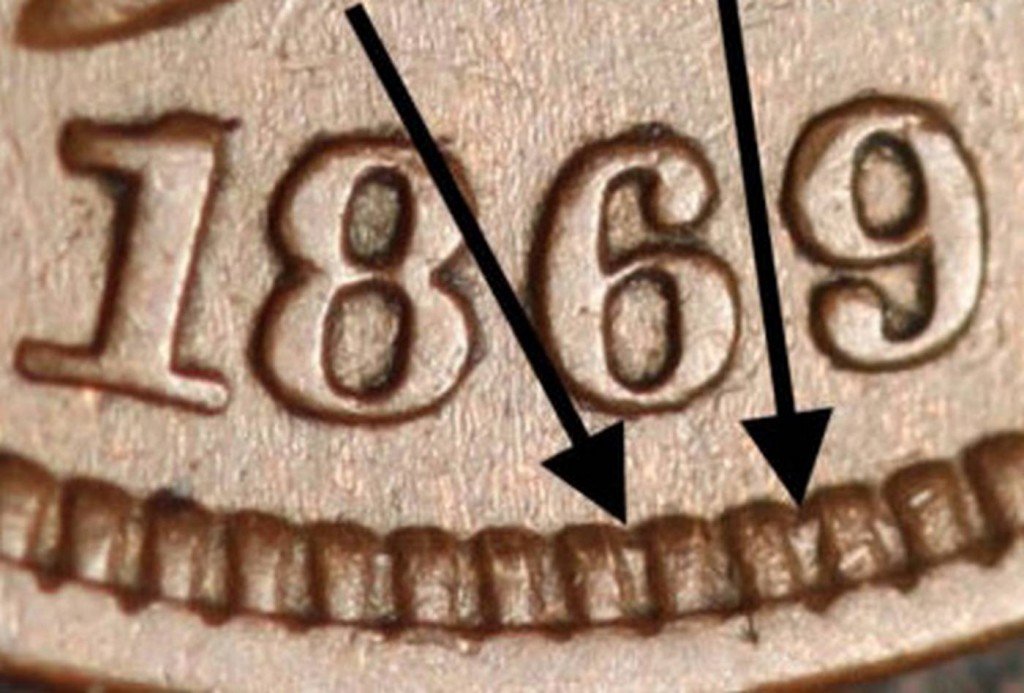
The Snow-8 misplaced date (MPD-001) is one of the most dramatic die-preparation errors on any 1869 cent. It resulted when the date logotype was first applied to the working die in the wrong position — too low — causing the tops of the 1869 digits to land in the denticle row. The die was then correctly punched at the proper position, but the errant impressions in the denticles remained permanently.

Under a 10× loupe, careful inspection of the denticles directly below the '8', between the '8' and '6', and between the '6' and '9' reveals the tops of misplaced digit impressions — tiny curved remnants of numerals that should not be in that zone. This diagnostic is confirmed in the Cherrypickers' Guide attribution system and cross-referenced as Snow-8 in the definitive Indian Cent die variety reference.

Because misplaced date varieties require careful die-by-die attribution and are catalogued at the URS-9 rarity level, they attract a dedicated collector base willing to pay premiums. Strike quality and preservation of the denticle area are especially important for this variety, as poor strikes obscure the very features that identify it.

How to spot it

With a 10× loupe, examine the denticles directly below and between the date digits — specifically below the '8', between '8' and '6', and between '6' and '9'. Curved remnants or tops of errant digit impressions embedded in the denticle band confirm this variety.

Mint mark

P — Philadelphia only (no mint mark on coin)

Notable

Catalogued as MPD-001 in the Indian cent variety system, cross-referenced Snow-8 and FND-006. Rarity estimated at URS-9 — approximately 250–500 examples known across all grades. Attribution requires verification by a specialist familiar with the denticle-level diagnostics for this die marriage.

1869 Indian Head penny reverse cud variety showing raised metal blob from die break between 2:30 and 3:30 o'clock position
Best Kept Secret
$100 – $4,500+

Reverse Cud Varieties (CUD-001 through CUD-005)

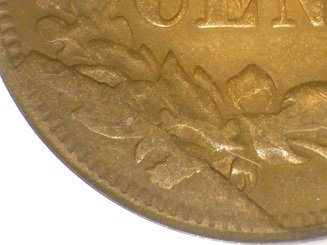
Cud errors occur when a section of the die face breaks away — typically at the rim — leaving a raised blob of metal on struck coins in that zone. For the 1869 Indian Head cent, five distinct reverse cud varieties have been documented, appearing at different clock positions on the reverse rim, most notably between 2:30–3:30 and 4:30–5:45 on the reverse die.

These varieties are identified visually without magnification in most cases — the raised blob of featureless, flat copper stands in stark contrast to the normally sharp denticle and lettering zone around it. Retained cuds (where the die segment is still partially attached) are catalogued separately from full cuds (where the die piece has dropped out entirely). The progression from die crack to retained cud to full cud documents the die's deterioration over its production run.

Cud varieties attract two distinct collecting communities: Lincoln cent and Indian cent type collectors who focus on the most dramatic visual examples, and die-variety specialists who pursue complete die-progression sets showing the crack, retained, and full cud stages. Late-stage full cuds command the strongest premiums, particularly when the cud obscures a significant portion of the "UNITED STATES" legend on the reverse rim.

How to spot it

Look at the reverse rim with the naked eye or a loupe — any raised, featureless blob of metal replacing part of the denticles or lettering indicates a cud. Common positions: between 2:30–3:30 and 4:30–5:45. Genuine cuds have a flat-topped raised profile; do not confuse with rim bumps from contact damage.

Mint mark

P — Philadelphia only (no mint mark). Multiple obverse dies paired with cud reverse dies.

Notable

Five cud varieties documented for 1869 (CUD-001 through CUD-005), attributed across multiple researchers including Marvin & Margolis (1979) and David Poliquin. CUD-002 is cross-referenced as Snow-3d; CUD-003 as Snow-3h. Full cud examples — especially those obscuring legend text — carry the highest premiums within this variety group.

Found one of these errors on your coin?

Use the calculator above to get a specific value estimate based on your coin's condition — it takes under a minute and gives you a realistic market range.

Get My Coin's Value →

1869 Indian Head Penny Mintage & Survival Data

Historical view of Philadelphia Mint circa 1869, where all 1869 Indian Head pennies were struck
Mint Mint Mark Business Strikes Proof Strikes Total
Philadelphia None (P) 6,420,000 est. 600 ~6,420,600
Totals 6,420,000 est. 600 ~6,420,600

Why So Few Survive?

The 1869 mintage of 6,420,000 was the lowest for any small cent in US history up to that point — a sign of economic contraction following the Civil War. More critically, the Mint Act of April 22, 1864, had shifted the bronze cent's denomination status without providing for formal government redemption. Banks routinely refused large deposits of small bronze coins, leading to a decade-long wave of private and institutional meltings.

Numismatic historian Richard Snow has documented that over 55 million bronze cents were melted in the decade following 1864. The 1869 cent was caught squarely in this destruction wave. Today's surviving population — particularly in grades above VF — represents a tiny fraction of original production, which is why even worn examples command $90 or more.

Composition Specifications

  • Metal: 95% copper, 5% tin and zinc (bronze)
  • Weight: 3.11 grams
  • Diameter: 19.00 mm
  • Edge: Plain
  • Designer: James B. Longacre (obverse and reverse)
  • Hub Type: Type 1 (used for most 1869 varieties)

How to Grade Your 1869 Indian Head Penny

Condition is everything for the 1869 cent — the difference between a worn G-4 example ($90–$120) and an MS-64 Red specimen ($3,000–$4,000+) is enormous. Learn the key checkpoints for each grade tier.

Grading strip showing four 1869 Indian Head pennies from worn G-4 through Fine F-12, Extremely Fine EF-40, to Uncirculated MS-63 condition

Worn (G–VG, $90–$148)

Device outlines visible but flat relief throughout. LIBERTY on the headband may be partially legible (VG) or fully worn away (G). Date readable. Rims may be weak. Still a collectible and valuable coin due to the semi-key date status.

Circulated (F–EF, $313–$559)

F-12: All seven letters of LIBERTY legible, moderate overall wear. EF-40: Light wear only on highest points — hair above ear, ribbon knot, leaf tips in wreath. Original brown or gray tone. Sharp date and clear legend at all grades in this tier.

Uncirculated (MS-60–63, $929–$1,200+)

No wear anywhere — confirmed by unbroken cartwheel luster under directional light. Contact marks (bag marks) acceptable at MS-60; fewer and smaller at MS-63. Most survivors are brown (BN); red-brown (RB) commands a premium at this tier.

Gem (MS-64+, $1,800–$84,000+)

Exceptional eye appeal, strong strike with full feather tip detail, minimal contact marks. Color designation is critical: BN = $1,847+; RB = $2,573+; RD = $3,280–$84,000+. MS-66+ Red examples are among the finest known and trade for life-changing money.

Pro Tip — Color Designation Matters Enormously: For any uncirculated 1869 Indian Head cent, the color designation (BN, RB, or RD) can double or triple the realized price at the same numerical grade. Before submitting for grading, store your coin in an inert flip holder away from light and air to preserve any remaining red copper color. Never use any coin dip, acetone, or cleaning agent on a coin with original luster — chemical cleaning destroys the surface chemistry that produces red designation.

🔍 CoinHix helps you cross-check your assessment by comparing your coin's appearance against thousands of graded reference examples in its database — a coin identifier and value app.

Where to Sell Your Valuable 1869 Indian Head Penny

The right venue depends on your coin's grade and value. Here are the four best options:

🏛️ Heritage Auctions

Best for: Certified MS-63+ examples, key varieties (1869/9 overdate), and proof specimens. Heritage reaches the largest global pool of specialized Indian cent collectors. The $84,000 record and most major 1869 auction results on this page come from Heritage. Consignment fees apply — best suited to coins worth $500 or more.

🛒 eBay

Best for: Circulated examples worth $85–$500 where speed matters. Search recent sold listings and actual 1869 Indian Head penny prices on eBay to price your coin accurately before listing. Use "completed listings" to see what coins actually sold for, not just asking prices. Free listings up to 250/month; 12.9% final value fee.

🏪 Local Coin Shop (LCS)

Best for: Quick, immediate sale with no shipping risk. Dealers will typically pay 60–80% of retail for common circulated examples. The 1869's semi-key status means most experienced dealers know its value well and will offer fair prices. Bring comparable eBay sold listings for reference. Ideal for heavily worn examples where auction fees would consume most of the proceeds.

💬 Reddit (r/Coins4Sale)

Best for: Mid-grade examples ($100–$400) where you want to sell collector-to-collector without fees. Post clear high-resolution photos of both sides under good lighting, state the grade clearly (raw or certified), and price at or slightly below eBay completed-listing prices. The community is knowledgeable about semi-key dates and responds well to fairly priced 1869 cents.

💡 Get It Graded First — For Any Coin Over $300

For any 1869 Indian Head penny you believe grades Fine or better — especially if it shows red color or a variety like the 1869/9 overdate — consider PCGS or NGC certification before selling. Certification typically costs $30–$65 per coin, but a certified MS-63 BN example selling for $1,064 vs. an identical raw coin selling for $500–$700 demonstrates the return on investment. Certified coins also sell faster and to a wider buyer pool. For variety attribution, PCGS uses the CAC designation system; Heritage Auctions accepts CAC-stickered coins and often achieves 10–20% premiums for green-label examples.

Frequently Asked Questions

What is the most valuable 1869 Indian Head penny ever sold?

The record holder is an 1869 Indian Head penny graded MS66+ Red by PCGS, which sold for $84,000 at Heritage Auctions in August 2019. This coin represents the finest known example in full red gem condition. Gem red specimens are exceptionally rare because most survivors toned to brown over 150+ years of storage.

How much is a worn 1869 Indian Head penny worth?

A heavily worn 1869 Indian Head cent in Good (G-4) condition is worth approximately $90–$120. In Very Good (VG-8) expect $148–$165. Even the most worn examples carry real numismatic value because the 1869 mintage of only 6,420,000 pieces — compounded by mass meltings in the 1870s — makes this a semi-key date across all grades.

What is the 1869/9 overdate and how do I identify it?

The 1869/9 (Snow-1, FS-301) is a repunched date variety where the entire date was stamped twice, leaving visible remnants of earlier digit impressions above and within the primary digits. Under a 10× loupe, look for a secondary '9' showing above the primary '9' in the date. It is catalogued as Snow-1 and is scarcer than the regular 1869 cent.

How many 1869 Indian Head pennies were minted?

The Philadelphia Mint produced 6,420,000 business-strike 1869 Indian Head cents plus an estimated 600 proof specimens. This was the lowest small-cent mintage in US history up to that point. Mass meltings of bronze cents in the 1870s — triggered by redemption policies under the Mint Act of 1864 — further reduced survivors to a fraction of the original mintage.

Is the 1869 Indian Head penny a key date?

The 1869 is considered a semi-key date in the Indian Head cent series. While it is not as rare as the 1877 (the true key date), it is significantly scarcer than most other dates. Its relatively low mintage of 6.4 million, combined with heavy attrition from post-Civil War coin meltings, makes quality examples elusive and highly desirable to collectors.

What does RD, RB, and BN mean on a graded 1869 penny?

These are color designations for copper coins. RD (Red) means the coin retains 95–100% original mint red luster and commands the highest premium. RB (Red-Brown) means 5–94% red remains. BN (Brown) means less than 5% red remains. For the 1869 cent, an MS64 RD is worth roughly twice an MS64 BN of the same grade number, so color designation dramatically affects value.

What are the most valuable error varieties on the 1869 Indian Head penny?

The most sought-after varieties include: (1) The 1869/9 RPD (Snow-1 / FS-301), a repunched date overdate; (2) Snow-2, another repunched date with die cracks; (3) Misplaced Date varieties (Snow-8 / MPD-001) showing digit tops in the denticles; (4) Reverse cud varieties showing raised metal blobs from die breaks. All carry premiums above the standard 1869 price.

How do I grade my 1869 Indian Head penny at home?

Focus on the headband lettering spelling LIBERTY — all letters fully visible indicates Fine or better. In Extremely Fine condition, hair feather details and the ribbon knot show sharp definition with only light high-point wear. For Uncirculated coins, unbroken mint luster must flow across the cheek, crown, and wreath leaves with no flatness on the highest contact points. Use a 10× loupe under a single directional light.

Should I clean my 1869 Indian Head penny before selling?

Absolutely not. Cleaning destroys the original surface and dramatically reduces collector value. An original brown patina — even dark brown — is preferred over a polished or dipped coin. Cleaned coins are designated 'details' by PCGS and NGC, which limits their marketability significantly. Leave the coin as-is and let a professional grader assess its natural state.

Where is the best place to sell a valuable 1869 Indian Head penny?

For high-grade or error specimens worth over $500, Heritage Auctions and Stack's Bowers reach the largest pool of specialized buyers and typically achieve the best prices. For mid-grade circulated coins worth $100–$500, eBay with completed-listing research is effective. For coins under $100, a local coin shop offers immediate payment with no listing fees or shipping risks.

Ready to Find Out What Your Coin Is Worth?

It takes under 30 seconds — select your mint, condition, and any errors you see, then hit Calculate.

Use the Free Calculator Now →